Opening up educational opportunities, one volunteer’s contribution to sharing experience across generations
Recent discussion about educational inequality has highlighted that improving educational outcomes cannot be left to schools alone. Young people also benefit from people and organisations beyond the classroom who can share experience, introduce new possibilities and help them navigate unfamiliar pathways.
For more than ten years, Anne Douglas has volunteered with the Intergenerational Mentoring Network (IMN), which began as a collaborative research and development project between researchers from the University of Strathclyde and a Headteacher at a local secondary school. Volunteers attending courses at the Centre for Lifelong Learning were invited to act as volunteer mentors, supporting young people from working-class and lower-income backgrounds navigate routes into higher education, competitive courses and the professions.
As a semi-retired Clinical Psychologist, Anne has shared her professional experience with young people, helping them explore the possibility of studying psychology and related subjects at university. In 2014 Anne began volunteering at Springburn Academy, where she was introduced to a young woman in S5 interested in studying psychology. Anne and her mentee continued to keep in touch as her mentee progressed through university and after achieving a 2:1 degree in Psychology from the University of Glasgow, Anne has provided further support, helping her mentee find work experience and helping her to prepare her application for a post-graduate degree which she has now completed successfully. Anne has also shared her experience of working in clinical psychology with other young people in IMN’s partner schools, helping them gain a better understanding of the profession and navigating pathways
Exploring further ways to address educational inequality
As IMN’s work has developed, we have explored other research-informed ways in which volunteers can support children at different stages of their education.
Our Help a Child Learn to Read project was developed with former Professor Sue Ellis, whose research on closing the poverty-related attainment gap in literacy has highlighted the value of supporting children’s engagement with reading by following children’s interests and existing knowledge of the world.
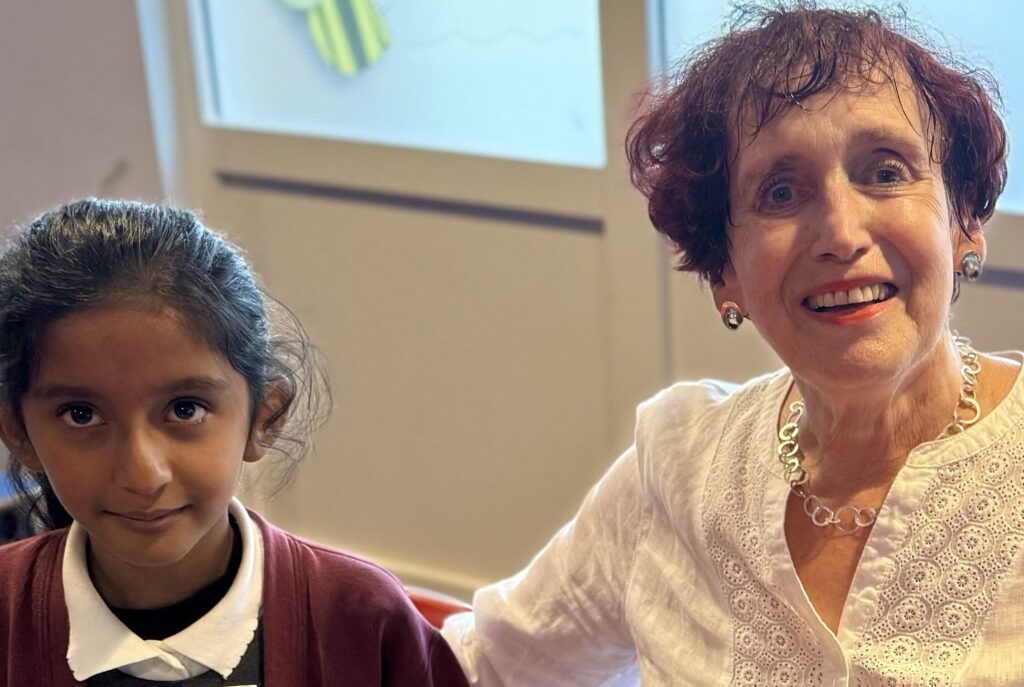
In 2023, Anne decided to take on a new challenge and began reading with two primary-aged pupils. This involves much more than practising reading. Anne takes time to get to know the children, encouraging them to ask questions, share what they already know and discover new interests. Their conversations have explored different countries and cultures, using maps and atlases and playing the World Game to find out more about the world. Reading together provides a starting point for following up questions and interests as they arise, giving children opportunities to share their knowledge, develop their curiosity and make new discoveries.
The Headteacher commented:
“I thoroughly value the commitment and dedication from all of the Reading Mentors. They are all very professional in their approach whilst developing really nurturing relationships with the children. It was clear to me that they had each taken time to get to know the children they were working with and showed real care for them as well as a desire to help them not only learn to read, but also to be seen by others for their strengths.”
The contribution volunteers can make
Our research and experience of working with schools and communities have highlighted the important contribution volunteers can make to widening educational opportunities. Sharing knowledge and experience across generations can help address educational inequality by giving young people access to ideas, networks and opportunities that might otherwise remain beyond their reach.
As an independent community interest company, IMN brings together volunteers, schools, community organisations and young people to create opportunities for learning and exchange between generations.
There are different ways to contribute. Volunteers can support children with reading, share their knowledge and experience with secondary pupils, and help young people explore university, professional pathways and future opportunities. Each volunteer brings something different, whether that is professional experience, an interest in a particular subject or simply a willingness to share their time and learn alongside a young person.
If you’ve enjoyed reading about Anne’s experience, please consider how your own knowledge, experience, interests and connections could help open up opportunities for a young person.
Could you share something from your own experience that might help a young person discover new possibilities?